 Find a Pain Clinic
 952-841-2345

 952-841-2345
Intrathecal Pain Pump – A Review
The intrathecal pain pump is one of the most advanced treatments for relieving chronic, intractable pain. It is a long-term, reliable, and low risk solution when other therapies have failed to provide adequate pain relief.
But what exactly is an intrathecal pain pump? What does intrathecal mean? What does it pump and how does it do it? We answer these questions and more to pull back the curtain on this miraculous marvel of medical technology.

KEY TAKEAWAYS
- An intrathecal pain pump is a device that automatically introduces concentrated pain medication into the cerebrospinal fluid at a controlled rate. This direct, targeted form of medication delivery can offer the same level of pain relief as oral opioids while avoiding risks such as tolerance, addiction, and overdose.
- Intrathecal pump therapy can treat a wide range of complex chronic pain conditions, including long-term back or neck pain, post-surgery pain, complex regional pain syndrome (CRPS), and cancer pain. Studies show that pump therapy routinely results in improved function, better quality of life, and reduced reliance on oral opioids.
- An intrathecal pump is implanted beneath the skin in the lower back/upper buttock area via a minimally invasive procedure that lasts no more than one hour. The pump is refilled as needed via a small needle during a brief clinic visit.
- Most insurance plans will cover intrathecal pump therapy, though your pain management clinic will need to obtain an authorization from your insurance carrier first. Most clinics will take the lead, or at the very least assist, in obtaining authorization.
TABLE OF CONTENTS
- What is an intrathecal pump used for?
- Is an intrathecal pump the same as taking opioids?
- What conditions does an intrathecal pump treat?
- How well does an intrathecal pump work?
- Where is an intrathecal pump placed?
- How often does an intrathecal pump need to be refilled?
- What are the risks of an intrathecal pump?
- Is an intrathecal pump covered by insurance?
What is an intrathecal pain pump used for?
First, let’s answer the question, what does intrathecal mean? The intrathecal space is the fluid filled region that exists between thin layers of tissue covering your brain and spinal cord. The intrathecal space contains cerebrospinal fluid (CSF), a clear fluid that surrounds the brain and spinal cord to help cushion them from injury and provide nutrients. This makes the intrathecal space a common site for administering certain kinds of medications.
An intrathecal pain pump is a device that automatically introduces medication into the body’s cerebrospinal fluid at a controlled rate. The medication spreads through the (CSF), where it bathes nerves and reduces pain. Also called targeted drug delivery, this method can provide as much pain relief as oral opioids while minimizing the negative side effects.
The intrathecal pump system is comprised of two components, the pump itself and a catheter. Both elements are implanted into the body and then connected to each other. The pump is then filled with concentrated pain medication via a tiny needle. Small amounts of the medication are pumped through the catheter and delivered directly into the intrathecal space.
Is an intrathecal pain pump the same as taking opioids?
An intrathecal pain pump does use some of the same medications that one might take as part of an oral opioid program. However, the medications are in a concentrated, liquid form and are introduced directly into a specific part of the spine where they will be the most effective.
Micro dosing
Intrathecal delivery requires a much smaller dose of medicine than oral opioids. This is why the therapy is often referred to as micro dosing. Micro dosing, delivered directly into the intrathecal space, allows the pump to provide the same amount of pain relief as oral opioids, while reducing the risks, such as:
- Tolerance: Using low dose intrathecal medication decreases the risk of tolerance, whereby your body “gets used to” the drug and needs higher doses to get the same level of relief.
- Addiction: The deceptively pleasant feeling of euphoria often caused by oral opioids is a result of the medication crossing the blood brain barrier. Since medication administered intrathecally does not cross the blood brain barrier, it can significantly relieve pain without causing the euphoria that can be so addictive.
- Overdose: Since micro dosing administers such small amounts of medication via controlled settings, the risk of overdose is drastically less than oral opioids.
- Hyperalgesia: Low-dose treatment also decreases the risk of developing opioid-induced hyperalgesia, which occurs when opioids cause chemical changes in your brain that actually make you more sensitive to pain.

What conditions does an intrathecal pain pump treat?
An intrathecal pain pump can effectively treat a variety of chronic pain conditions, including:
An intrathecal pump can also be filled with a medication called Baclofen, which can be used to treat spasticity in patients with:
- Cerebral palsy
- Multiple sclerosis
- Stroke
- Brain injury
- Spinal cord injury
Intrathecal pump therapy is commonly prescribed for patients who have tried other, more conservative therapies to treat their chronic pain, but have had little to no success.
It is important to note that pain pump therapy does not eliminate the source of your pain or cure any underlying conditions. But it can help manage your pain so you can enjoy a better quality of life.

How well does an intrathecal pain pump work?
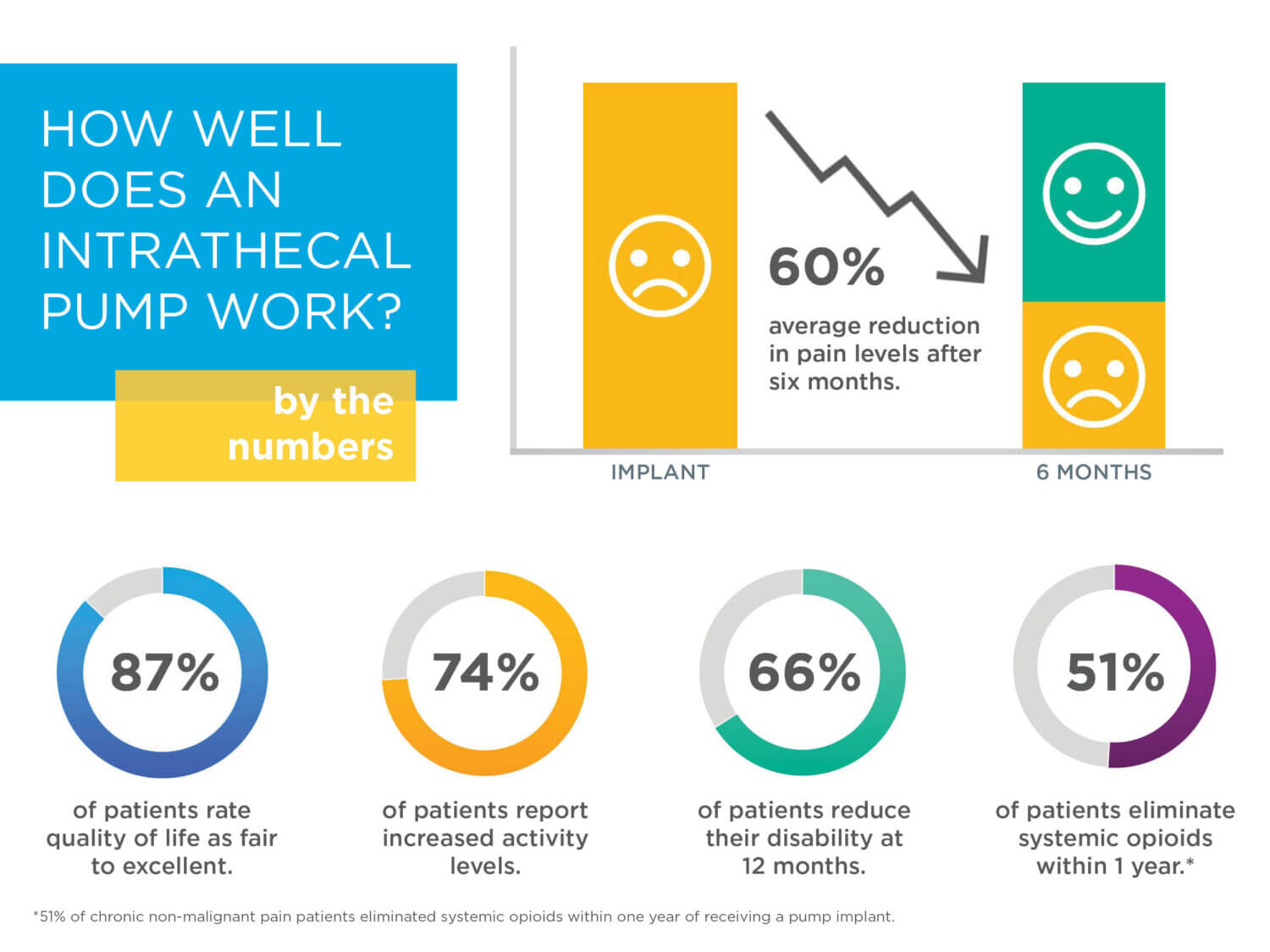
Studies published by Medtronic, one of the world’s leading experts on and producers of intrathecal pumps, indicate that pumps have a significant positive impact on the recipient’s quality of life.
- On average, pump patients experienced a 60% reduction in pain after six months1
- 87% of patients rated their quality of life as fair to excellent1
- 74% of patients reported increased activity levels1
- 66% of patients successfully reduced their disability at 12 months1
- 51% of chronic non-malignant pain patients eliminated systemic opioids within one year of receiving a pump implant1*
These promising results are supported by extensive clinical research. But as with any medical procedure, no specific result can be guaranteed. Each patient may respond differently to intrathecal pump therapy. However, the evidence suggests that an intrathecal pump implant is extremely likely to provide improved quality of life.
Where is an intrathecal pain pump placed?
The intrathecal pain pump is typically placed in a small space, or “pocket,” in the lower back or upper buttock. A small incision is made in the skin, and the pump is positioned by the surgeon in the proper location. The device is implanted near the surface of the skin to allow for easy refilling. The incision is then stitched back up and a bandage applied.
A pain pump implant is a minimally invasive, outpatient procedure that generally takes no more than an hour. The patient returns home the same day.
Since the pump is placed securely under the skin, it can do its job for many years without interfering with the patient’s daily routine.
How often do you refill an intrathecal pain pump?
How often a pain pump needs to be refilled depends on the concentration and amount of medication your therapy uses. Refills may occur every six weeks up to every six months. Your pain management provider will inject the refill medication into the pump via a small needle.
Refill appointments are brief outpatient visits. Your provider will also take this time to check that the pump is working correctly and adjust the dosage if necessary.
What are the risks of an intrathecal pain pump?
Being a minimally invasive procedure, intrathecal pain pump therapy is a very safe treatment for chronic pain. But, like with any procedure, there are a few risks. It is important to remember that all these risks are very uncommon, with the more severe complications being especially rare.
Many of the risks associated with a pump implant are the same that come with any surgical procedure. These include bleeding at or near the incision site, infection, and nerve damage.
Some other medical risks more specifically associated with the intrathecal pump implant include:
- The formation of an inflammatory mass at the tip of the catheter – this is known as a granuloma and as it grows, it can infringe on nearby nerves and cause neurological pain.2
- Cerebrospinal fluid (CSF) leakage – when the needle used to place the catheter is removed from the intrathecal space, some leakage of CSF may occur.2
Your pain management physician has methods to detect these kinds of abnormalities and can take steps to treat them if they occur.
Lastly, the pain pump itself may experience certain mechanical issues, including:
- The pump becoming dislodged from its pocket and moving2
- Fracture or breakage of device2
- A kink in the catheter2
- A puncture in the catheter2
- A leak in the pump2
- Catheter becoming disconnected from the pump2
Once again, these risks are exceptionally rare, and even if a complication does arise, your care team will know exactly how to address it.
Is an intrathecal pain pump covered by insurance?
Intrathecal pump implant procedures are generally covered by most insurance carriers. Your pain management provider will need to obtain approval from your insurance carrier before the procedure can be performed. Approval criteria might vary by carrier and your pain management clinic will help ensure those requirements are met.
For more information on insurance plans that we accept and our insurance process, you may visit our insurance and billing page.
Conclusion
Intrathecal pump therapy is an advanced, highly effective treatment for a variety of chronic pain conditions. Its unique and direct method of administering medication makes it a long-term, low risk alternative to opioid medications.
For a real-life example of how life-changing an intrathecal pump can be, hear from one of our pump patients, Cheri Haberle. Cheri developed a severe case of rheumatoid arthritis that accelerated the deterioration of seven different discs in her spine. Before long, she could barely stand for more than a few minutes at a time. After many failed efforts to seek care, she found Twin Cities Pain Clinic, who prescribed her the intrathecal pain pump that changed her life.
Still have questions?
- Learn more about the intrathecal pain pump procedure>>
- Schedule a consultation>>
The contents of this article are intended for informational and educational purposes only and are not intended as a substitute for professional medical advice, diagnosis or treatment. Always consult with a physician or other qualified healthcare provider before engaging in any action or decision-making based on the content of this article. Never disregard or delay seeking professional medical advice or treatment because of the content of this article or any other content on the Twin Cities Pain Clinic website. Reliance on any information conveyed on the Twin Cities Pain Clinic website without direct consultation with a healthcare professional is solely at your own risk.
References
- https://www.medtronic.com/us-en/healthcare-professionals/therapies-procedures/neurological/targeted-drug-delivery/clinical-outcomes/chronic-pain.html
- Knight, K. H., Brand, F. M., Mchaourab, A. S., & Veneziano, G. (2007, February). Implantable intrathecal pumps for chronic pain: Highlights and updates. Croatian medical journal. Retrieved May 9, 2022, from https://www.ncbi.nlm.nih.gov/pmc/articles/PMC2080496/
Author Bio


